El rodillo en los sistemas de ventanas correderas: mecánica, dinámica del desgaste y optimización del rendimiento.
ARTICLE NO.133 | The Roller in Sliding Window Systems: Mechanics, Wear Dynamics, and Performance Optimization
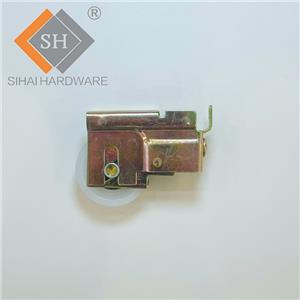
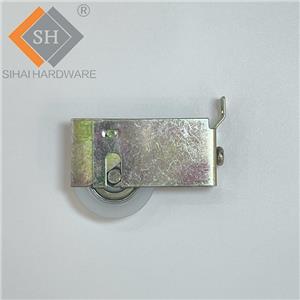
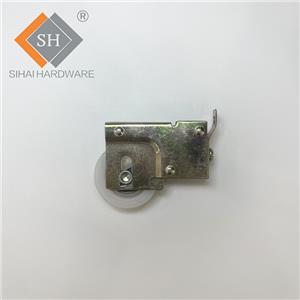
The roller assembly, hidden within the bottom rail of a sliding window sash, bears the entire weight of the glazed panel while enabling effortless horizontal movement. When functioning correctly, users take its performance for granted. When it fails—through wear, corrosion, or misalignment—the window becomes difficult to operate, the track sustains damage, and the entire system loses functional integrity. Understanding roller design, material selection, and degradation mechanisms is essential for those who demand longevity from sliding window installations.
Load Distribution and Contact Mechanics
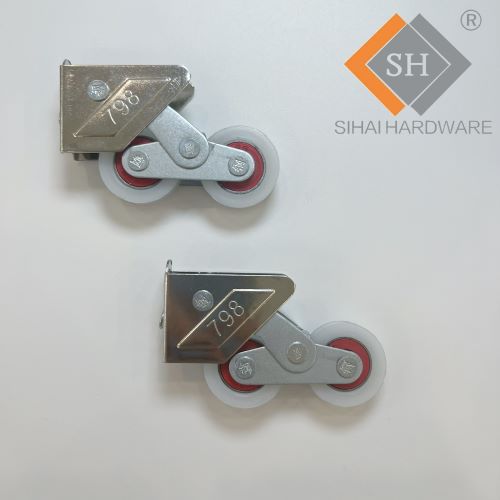
A sliding window roller transfers sash weight to the track through a remarkably small contact patch relative to the load carried. A typical residential sash weighs 25 to 80 kilograms, yet this weight concentrates on two rollers, each contacting the track over perhaps 10 to 30 square millimetres. This produces contact pressures from 8 to 40 megapascals, depending on roller diameter and tread profile. Hertzian contact theory governs stress distribution at the interface: a cylindrical roller on a flat track produces line contact with peak subsurface shear stress occurring beneath the surface. Fatigue crack initiation typically originates at this subsurface maximum, meaning spalling of the roller tread is frequently a subsurface-initiated failure mode rather than surface wear.
Material Selection and Performance
The roller material fundamentally determines load capacity and service life. Residential rollers are commonly injection-molded from engineering thermoplastics—acetal homopolymer, nylon 6/6, or glass-fiber-reinforced polyamide—offering adequate strength, inherent corrosion resistance, and quiet operation. Acetal rollers exhibit a low friction coefficient of 0.15 to 0.25 against aluminium tracks. However, thermoplastic load capacity is limited by creep deformation: a roller supporting 40 kilograms stationary for extended periods gradually develops a flat spot, producing an audible thump during operation and concentrating impact loads. For heavy commercial doors exceeding 100 kilograms, rollers transition to ball-bearing designs with steel or stainless steel treads, offering capacities up to 200 kilograms per roller and dramatically reduced rolling resistance.
Bearing Configuration and Rolling Resistance
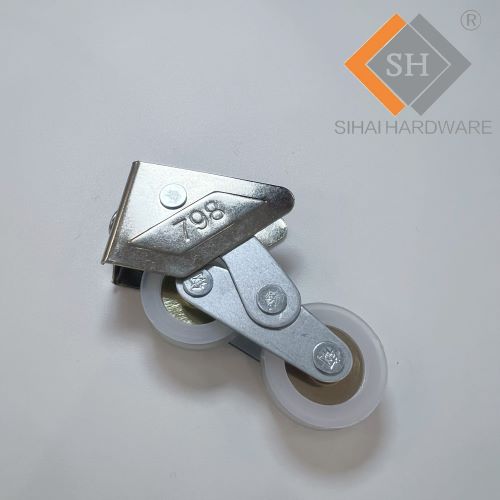
Internal bearing design distinguishes high-performance roller assemblies from basic ones. The simplest configuration runs a plain bore directly on a fixed axle—pure sliding contact with high friction. The next level introduces a sleeve bushing between roller body and axle. Premium rollers incorporate deep-groove ball bearings or needle roller bearings, converting sliding to rolling friction within the bearing itself. A plain-bore roller exhibits a rolling resistance coefficient of 0.05 to 0.10, while a ball-bearing roller reduces this to 0.005 to 0.015—an order of magnitude improvement. This becomes critical for heavy sashes where excessive operating force would violate accessibility standards specifying maximum forces between 45 and 90 newtons.
Track Interface and Alignment
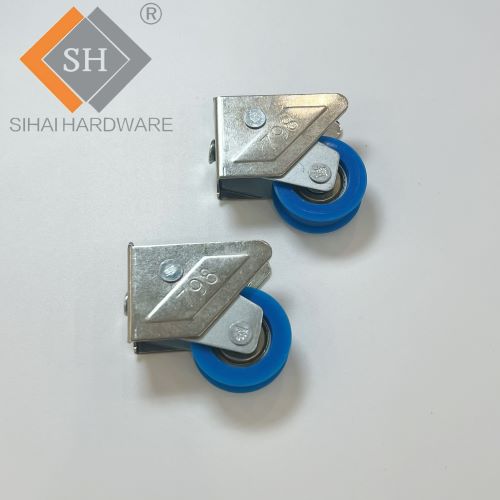
The roller and track form an interdependent system where misalignment accelerates wear exponentially. Track surfaces must be flat within 0.3 millimetres per metre, free of burrs and debris. Roller axles must be parallel and perpendicular to travel direction; an axle skewed by even 2 degrees introduces thrust that forces the roller against track sidewalls, increasing resistance and generating abrasive debris. For adjustable assemblies, the height mechanism must be set so both rollers share the load equally. A 60/40 load imbalance reduces the more heavily loaded roller's service life by approximately 30 percent.
Environmental Degradation and Sealing
The roller operates in a hostile environment—the bottom track collects dust, sand, insect debris, and cleaning residue. Exterior doors face rainwater that can pool and submerge the assembly. Sealed bearing designs are essential, with rubber contact seals or labyrinth seals preventing particulate ingress while allowing free rotation. Grease specification matters: standard lithium soap greases emulsify in water, losing lubricity; marine-grade calcium sulfonate or polyurea greases provide superior moisture resistance. In coastal environments, 316 stainless steel rollers with sealed ceramic hybrid bearings offer maximum corrosion protection.
Wear Mechanisms and Lifecycle
The roller degrades through several mechanisms. Abrasive wear occurs when hard particles become trapped between tread and track. Adhesive wear develops at the axle-bearing interface under boundary lubrication. Surface-initiated fatigue manifests as micropitting after extended cycles. Typical service life ranges from 10,000 to 50,000 cycles—3 to 15 years at 10 daily operations. Rollers are often replaced early due to user dissatisfaction with increased effort rather than complete failure. Annual track cleaning and roller inspection identify early signs before sash alignment is compromised.
Conclusion
The sliding window roller concentrates substantial loads onto small contact areas, relies on precise alignment for low resistance, and withstands hostile environmental conditions. Material selection—thermoplastic versus metallic, plain versus ball-bearing—determines the system's operational envelope. For specifiers, understanding load ratings, bearing types, and corrosion resistance enables informed selection. For maintenance providers, recognising early degradation indicators allows timely intervention before track damage escalates costs beyond simple roller replacement.